Challenge: Rescuing a stalled insurance agent portal redesign hampered by poor governance, vendor friction, and a “source of truth” prototype that didn’t actually work.
Deliverables: Design System Audit, Content-First Framework, Agile Governance, Figma Prototyping.
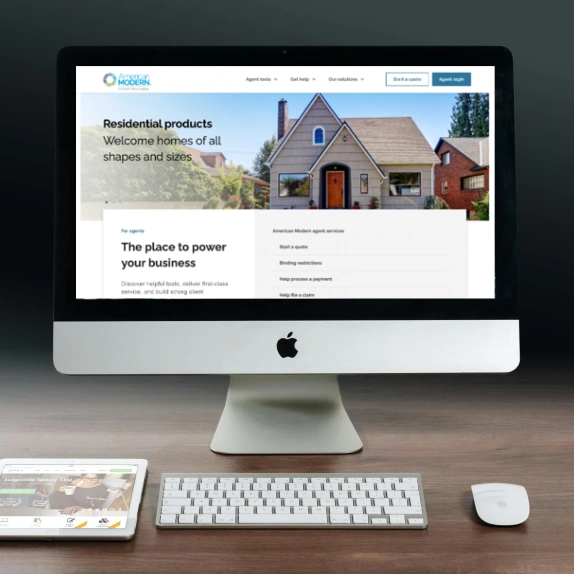
Impact: Extended from 3 to 8 months to lead the full digital transformation and bridge the gap between 5 vendors and the client.
We stepped into a high-stakes redesign for a major insurance provider that was struggling with ‘too many cooks in the kitchen.’ With five different vendors, a client resistant to Agile, and a design vision inherited from a previous firm that was unactionable, the project was at a standstill. My task was to turn this ‘loosely coupled’ governance into a streamlined design-to-development pipeline.
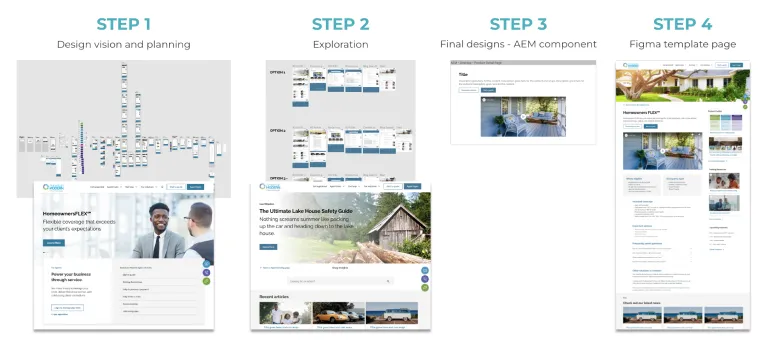
The ‘Rescue’ Goal: Audit and fix the inherited ‘Source of Truth’ prototype to make it technically feasible.
The Content Goal: Break the silos between Marketing (Content) and Design to stop ‘content clashing.’
The Technical Goal: Educate the team on AEM (Adobe Experience Manager) integration to ensure designs could actually be built.
In this case, the “users” were the internal teams and agents. I conducted an internal audit to find out:
Why was the inherited design vision failing the development team?
What are the specific ‘Business as Usual’ constraints of the marketing team?
Where is the friction in the 5-vendor Agile workflow?
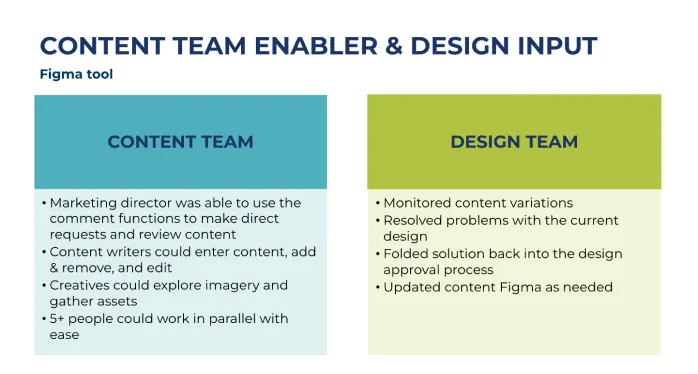
The research revealed a massive misalignment: marketing was writing content for a site that the design templates couldn’t hold. I synthesized these findings into a Content-First Approach, moving away from ‘designing for lorem ipsum’ and toward designing for real insurance data and agent needs.
I redesigned the collaboration model. Instead of working in a vacuum, I brought the Marketing and SEO teams into the Figma environment early. We created ‘Placeholder-Actuals’—prototypes that used real marketing copy—to prove the design’s scalability before a single line of code was written in AEM.
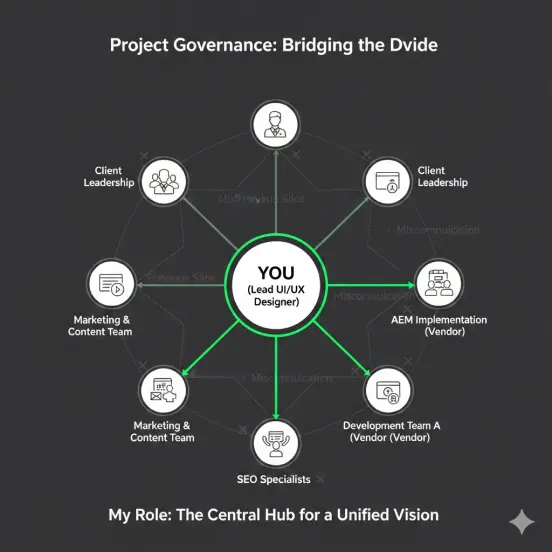
Using Figma as a ‘live negotiation table,’ I built a clickable prototype that served as the new, functional source of truth. I coordinated directly with developers to ensure every sprint was backed by a design that was already vetted for technical constraints, reducing the ‘re-work’ loop that had previously plagued the project.
We validated the new process through three successful iterative sprints:
The Result: Eliminated content-clashing by 100% through early collaboration.
The Shift: The client moved from being ‘resistant to change’ to fully embracing the Agile ceremonies I helped establish.
The Expansion: Due to the success of this new governance model, my initial 3-month contract was extended to 8 months to oversee the full launch.
This project taught me that UX Design is often 50% interface and 50% diplomacy. Being a designer in a multi-vendor environment means being a bridge-builder. By prioritizing Content-First Design and clear communication, we transformed a failing handover into a successful, scalable insurance portal.”